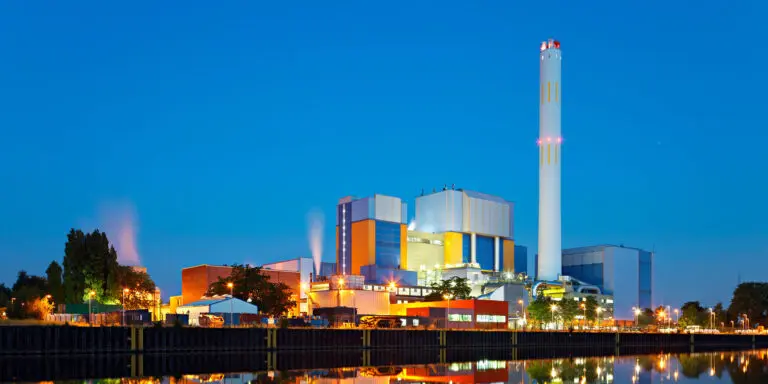


Several final recommendations in the Victorian Parliament Final Report align closely with policy positions presented in WTEI’s Submission No. 433
The Parliament of Victoria has tabled the Final Report of its Inquiry into the development and expansion of waste-to-energy (WtE) infrastructure in Victoria.
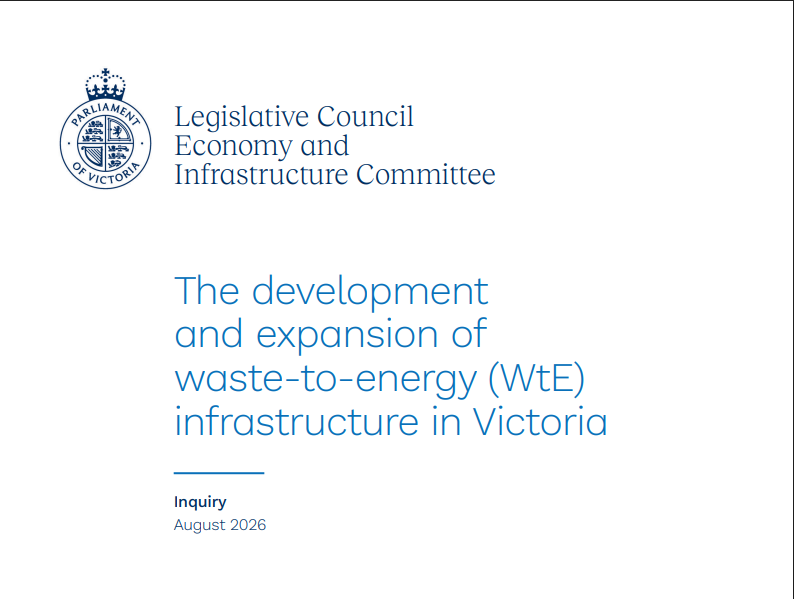
Waste to Energy International (WTEI) was among the stakeholders the Legislative Council Economy and Infrastructure Committee directly invited to contribute to the inquiry. The Committee initially contacted 117 stakeholders seeking formal submissions. By the close of the consultation process, it had received 627 submissions from organizations and individuals. More than 90% came from individual community members, while international submissions represented less than 0.5% of the total.
WTEI’s contribution was formally published as Submission No. 433 and is listed in the Final Report’s official record of evidence.
Victorian Parliament Final Report
The Committee’s Final Report contains 59 findings and 33 recommendations covering residual waste management, WtE capacity, environmental regulation, emissions monitoring, ash management, planning, transport impacts and community consultation.
Several of the Committee’s final recommendations align closely with positions advanced in WTEI’s submission.
In particular, the Committee recommended that Victoria introduce periodic public review of the thermal WtE cap. The review should consider actual and projected waste generation, facility throughput, project progress, and competition for available feedstock. This reflects WTEI’s position that WtE capacity should be determined through evidence-based analysis of real waste availability, project scale, logistics and regional conditions.
The Final Report also recognized that waste-to-energy is not a single technology. It also recommended assessing different technologies by feedstock requirements, operating scale, environmental performance, useful outputs, and management of residual by-products. This closely reflects WTEI’s technology-matching approach to grate combustion, pyrolysis and smaller modular thermal solutions.
Another area of strong alignment is environmental transparency. The Committee recommended independent emissions auditing, continuous emissions monitoring and real-time public reporting wherever technically feasible — principles also emphasized in WTEI’s submission.
The report further recognizes the broader environmental and economic liabilities of landfill. This includes methane emissions, leachate, long-term site management and post-closure obligations. The Committee concludes that landfill is both environmentally and economically costly and that reducing reliance on it remains an important objective of Victoria’s waste-management system.
Next Steps
Importantly, the Committee also acknowledges that eliminating residual waste entirely is unrealistic and that some form of residual-waste management will always be required.
The Final Report does not attribute individual recommendations to WTEI or other specific submitters. However, the consistency between several of its conclusions and the policy positions set out in WTEI’s submission reinforces the relevance of international technical and project-development experience in shaping evidence-based WtE policy.
Following publication of the report, the Committee Secretariat thanked WTEI for its contribution to the Committee’s work. Final Report tabled: Inquiry into the development and expansion of waste-to-energy (WtE) infrastructure in Victoria
The Victorian Government now has six months to provide a formal response to the Committee’s recommendations. That response will also be made public. lceic-60-09-the-development-and-expansion-of-wte-infrastructure-in-victoria.pdf
Official Final Report:
Parliament of Victoria — Waste-to-Energy Inquiry Reports